Showing posts with label Youth Athletics. Show all posts

Thursday, July 12, 2018

5 Tips on Becoming a Better Coach (Continued)

In the last blog post I mentioned how the 5 tips on becoming a better coach are endless.  The tips of my fingers and mind wanted me to continue! Here are tips 6-10 to go along with the last post Click here to read.  For most, this list should change and evolve year by year. This isn’t an end all be all list, but should bring about discussion within your sports program or individual practice.  Please share this and comment on if you disagree or agree with any of the tips. It’s a great way to see what methods others use that have been positive or negative.  The only way we can continue growing our community and service those we work with is by engaging in thoughtful and respectful dialogue.

6) The top athlete on your team isn’t who you should spend most of your time with.  In order to build a solid program, you have to build from the bottom up
I observe everything. I could probably make it a full-time job if I wanted to.  Over the years of observing how coaches approach instructing teams and individuals, this is something that has always stuck out like a sore thumb; coaches putting all of their time and effort only into their number one player.  I get it. Your number one player is often the captain, the leader, the glue that holds your team together, but in my opinion, they don’t need 100% of the attention.  Delegate duties to those who can handle them and work on your team from the ground up.
One of the most common complaints parents have with athletics is their son or daughter not getting the attention needed to improve as an athlete.  Word of advice to coaches:  Spend more time with the athletes that need a little more attention to develop.  Your team is only as good as the last guy/girl on the bench.  Ignoring the athletes that aren’t as gifted says a lot about you as a coach and can have a negative impact on your program.
Now, there will be many coaches out there that say its “too hard” to help those kids that aren’t as talented.  I agree and it is hard, but spending more time doesn’t always mean making them an elite athlete.  Sometimes all an individual needs is to feel like they are part of the team or their hustle and consistency of showing up everyday is being recognized.  This can be the difference between changing a young kids life or having them leave your hands with a bad experience.  Remember, the most talented athlete on your team doesn’t need 24/7 supervision or helicopter coaching.

7) Sometimes allowing them to coach themselves is necessary
Earlier this year Steve Kerr, of the Golden State Warriors, took a step back and allowed his players to coach themselves during a game.  Some viewed this as arrogant while others applauded him.  I applauded him for this move.  Sometimes we as coaches need take a step back and allow athletes to organize and learn on their own.  This not only gives you feedback on if what you’re teaching is connecting with your group, but this also allows the players an opportunity to make adjustments without you stepping in.  This can be great practice for teams needing to make adjustments on the fly during their competition.
With most athletes I coach on the private side this topic comes up often.  I keep an engaging environment and I challenge athletes to talk through and figure out certain concepts I teach on their own.  The last thing you want is your athlete to be overly dependent on you.  Let them be students, but don’t spoon feed them.

8) Keep the environment engaging and mistake friendly
MISTAKE FRIENDLY.  -Coaches, STOP yelling at your athletes for every little mistake they make.  I will give you an example of the effect this has.  Recently, I was at a local track working on a few sprinting concepts with an athlete. I saw a dad and his two boys practicing on their baseball skills, which is always great to see.  As I took more time to observe, I noticed that any time the son would miss a ground ball or make a mistake, his dad would yell at him in disappointment.  The more and more the dad yelled at his son’s mistakes, the more timid the son became. It got to the point where the son was so flustered with trying to get a ground ball that his reaction time slowed down significantly from when I first began observing.
Another example:  Over the past 5 years I have had opportunities to work with various teams on the middle school and high school levels.  As many coaches know, the performance or strength and conditioning coach has access to information that the team coaches don’t always get.  One day I was curious to see how the athletes liked their coach yelling when they made mistakes.  The majority of the athletes said that when they make a mistake and get yelled at for it, it makes them more nervous to make another mistake.
Coaches, please use these examples as an educational moment.  Yes, I understand there are times we yell when angered or out of excitement, but understand that the reason your athlete’s may not be competing to the best of their ability is possibly due to the negative tone or approach you take when your athlete’s make mistakes.  Sometimes, you have to address these issues with a more educational approach rather than resorting to yelling.  You may feel the need to always have your voice heard, but it isn’t about you.
From experience, yelling doesn’t work for my style of coaching.  If I have an athlete make a mistake, I use the mistake to educate them instead of yelling at them.  A few months ago I had an athlete miss their running event at a track meet.  I was frustrated because twenty to thirty minutes prior to that incident, I reminded the team to pay attention to when their events are called.  Rather than blowing a vein in my forehead, I educated that athlete on the importance of taking responsibility.  That athlete was disappointed and felt guilty for missing the event, so yelling or shaming wasn’t necessary.  Most athletes know and understand their mistakes and try their best to learn from them. Yelling, in my opinion, adds more anxiety and an increased chance of the same mistake happening again.

9) Learn how to read body language and energy
A must. A must. A must. This by far is one of the most valuable t assets I’ve been blessed to have in my coaching toolbox.  I work with many middle school and high school kids on the private side, and coach a high school boy’s and girl’s track team.  I deal with a number of personalities, backgrounds, and levels of athleticism.  Why is this information important?  It’s important to illustrate the various numbers of athletes I work with and importance of being able to read body language and facial expressions.  Not having this asset in some regards would make coaching difficult.  There are times when I have had teams show up to practice and as soon as they walked through the door, I could feel their energy.  I have athletes show up for individual lessons and I can tell what type of energy they are going to have for the session based off of the way they walk and tone of their voice.
I like to joke with many of my athletes and tell them I work for the CIA because of my keen detective skills.  All jokes aside, this isn’t something you are taught when you decide to test the waters of coaching athletes.  I believe it’s all about a coach taking the time to observe each individual, having general knowledge about human behavior, and truly understand what it means to be a coach.  The book Conscious Coaching by Brett Bartholomew is also a great resource to have.  These tools will slowly give you a better understanding and help you determine the approach to take when coaching your team.  Over time, you will be able to assess and judge how your teams act after a win, tough loss, or a week full of final exams.   Learning energies and body language isn’t hard.  It just takes a coach willing enough to pay attention to his or her athletes to become good at it.

10) Let it be known that you have an open door policy.  Being a “hardass” sometimes scares athletes away from opening up to you. 
Last but not least, keep an open door policy.  This goes back to communicating and doing it well.  I can’t tell you how many times some of my athletes have come to me to talk about a private topic.  Some topics have caused me to lose sleep at night, but that is part of being a coach. Some believe this is crossing the line or that coaches shouldn’t open the doors to athletes that have tough topics to discuss.  I completely disagree.  Sometimes a coach is all an athlete may have or the only person they are comfortable talking to.  No, the role of “therapist” doesn’t fall under the category of coaching, but sometimes those are the cards we are dealt.   Side note: (Never try to diagnose an athlete or get yourself involved in family or legal issues your athlete may have.  Be extremely supportive, but let professionals handle those types of situations).  Not comfortable talking to athletes about tough topics?  Delegate and get that student athlete what he or she needs. The last thing you want to do is scare an athlete by your inability to stay calm and relaxed when certain topics come up.  It will eventually happen, so be prepared and know what you need to do.
In closing, I hope these tips and topics have made you think more on what being a coach is all about. We aren’t perfect and this list WILL NOT automatically make you a better coach.  This list is intended to help you along your journey of eventually becoming a better coach.  I don’t consider myself a seasoned veteran by any means, but I know the approach I take with coaching has been extremely rewarding and successful.
______________________________________________________________________________
Kendrique Coats is the owner of Coats Performance, which provides speed and agility training in Frisco, Texas and surrounding areas. Over the years, Coats has spent most of his coaching time on the high school level coaching boys and girls track and field as well as overseeing strength and conditioning programs, which included stops at Pontiac Township High School in Illinois and Bloomington-Normal, Illinois. Now the head track and field coach at Dallas International School in Dallas, Texas, Coats looks to bring many of his training and coaching philosophies to the new program. Coats has written several articles including “Why I Stopped Yelling and Started Coachingalong with Early Sports Specialization. For more on Coach Coats and his work, be sure to follow on Twitter @kendriquecoats, Instagram @CoatsPerformance, and his website www.coatsperformance.com. You can also connect with Coach Coats via email at kcoats@coatsperformance.com

5 Tips on Becoming a Better Coach


5 Tips on Becoming a Better Coach
Coaching is fun, stressful, and extremely rewarding if you’re in it for the right reasons. I often find myself critiquing my coaching style and approach daily. If you’ve been around me or have talked coaching with me you will find that this is not something I take lightly. Why? Have you ever had an opportunity to positively impact an athletes experience and potentially life? This is why I work my hardest on ways to improve as a coach and teacher.   Here I have compiled five tips to help coaches that are continually looking for material that will help them along their coaching journey. By no means is this an end all be all list, but rather, thought provoking concepts and ideas that create deeper thinking than just x’s and o’s. Could the list go on forever? Certainly, but most that coach don’t have an unlimited amount of time for a novel, so I’ll keep it short. I hope these tips get you thinking and create discussion on various aspects of becoming a better coach.

1) Let them have a voice
Is it risky? Yes, but only if your group doesn’t respect you. Over the years I have backed away from taking control of every situation. With many of the teams and athletes I work with, I always encourage them to respectfully ask questions on what I teach and to speak up/voice their opinion if something doesn’t seem right. I’ve always had the approach that allows athletes to voice how they feel or if they dislike something in their training. One rule- they must have a thought out explanation on why they dislike something. Why do I allow this? It’s a great way to get feedback on what we do during training and it gives them a chance to feel like they have more ownership of the team and their development.

Secondly, I want them to feel respected and have the freedom to express themselves. I think one of the biggest issues many coaches have, including myself at times, is not fully allowing a team(s) to have their own identity. Word of advice- if you keep a team from having their own identity it can negatively impact overall chemistry and success.

Third and most of all, I want them to have the ability to speak up when they get into the real world. When we are younger, we have no trouble speaking on what we feel, but with age, we get away from this.   The power of expression is priceless. Let your team express themselves in their own unique ways, but make sure they respect you before doing so.

2) Know when to back off
Tip number two should come as no surprise, but there are times we can be overbearing or overprotective. We must learn to back off and let young teens have their independence with friends at practices or during competitions (depending on sport). I’ve learned that constantly checking in or helicopter-monitoring athletes often causes more stress than necessary. With younger athletes this may be an exception, but with older athletes, they don’t always need helicopter coach them. Be there for them when they need you, but allow them their freedom. They will thank, respect, and appreciate you for trusting in them.

3) Take time understanding your group and then adapt
Learning how to coach isn’t always about how well you can doodle on a white board or the world class pregame motivational speeches that could’ve been used in a movie. You have to understand the dynamics of your team and how to properly coach them. Sometimes when we think of coaching we don’t think about the intricate parts of understanding people, how to work with people, and how to communicate with people. Some of the best coaching seasons I have had have been from my ability to understand the needs of each athlete on the team and how to adapt my coaching style to each one of them. Having a bullheaded approach and trying to fit the whole team to your style typically doesn’t go over well.
I’ve always viewed coaching as a chameleon in the jungle. The chameleon has the ability to camouflage itself to fit the environment in order to avoid being seen by predators. If you do not adapt as a coach, your audience will make the season difficult, which may cause you to become overwhelmed by stress (the predator).

4) Communicate, communicate, and communicate
You must be a coach that communicates. It always baffles me when I see athletes during their training sessions and they talk about some of their coaches don’t communicate well with them. Not saying you have to be as smooth with your words, but I believe it is important to be clear with what you communicate. I don’t know about you, but I have had many jobs growing up. The jobs I typically disliked were jobs where there was a disconnection between management due to a lack of communication. Coaches, the more you communicate with your team (good, bad, or ugly) the more you will find them opening up and expressing themselves. As a former athlete, nothing irritated me more than not feeling comfortable approaching or simply chatting with a coach because of their inability to keep an open line of communication with the whole team.

5) Have high expectations, but be realistic
This is something that all of us coaches need to be aware of. It’s easy to get excited at the beginning of a year. Some get overly excited to the point of making promises or setting unrealistic goals. Try your best to have expectations such as being on time, caring for teammates, never give up, and always keep the team goals in front of individual goals. These types of expectations are ways to build a program, if you’re a new coach. Promising to get to the playoffs or win multiple titles can come back to hurt you and your relationship with your team and parents.
As a coach, I never make promises because I understand how a season can change (learned this the hard way). What I do make is a conscious effort to always give the best of myself to the teams and individuals I coach; have high expectations that aren’t centered around wins-loses; and I always hold myself and my teams accountable for all actions.   Promises are dangerous. Be realistic with expectations, but careful when make guarantees.
_____________________________________________________________________________________
Kendrique Coats is the owner of Coats Performance, which provides speed and agility training in Frisco, Texas and surrounding areas. Over the years, Coats has spent most of his coaching time on the high school level coaching boys and girls track and field as well as overseeing strength and conditioning programs, which included stops at Pontiac Township High School in Illinois and Bloomington-Normal, Illinois. Now the head track and field coach at Dallas International School in Dallas, Texas, Coats looks to bring many of his training and coaching philosophies to the new program. Coats has written several articles including “Why I Stopped Yelling and Started Coaching along with Early Sports Specialization. For more on Coach Coats and his work, be sure to follow on Twitter @kendriquecoats, Instagram @CoatsPerformance, and his website www.coatsperformance.com. You can also connect with Coach Coats via email at kcoats@coatsperformance.com

The Eye Holds No Vision

“The eye holds no vision” --By: Coach Sean Light


As I write this article, I’m sitting in a Starbucks on East 84th Street in Manhattan. A taxi cab is stopped outside the window to my left, the pedestrian crosswalk signal is flashing, there's an older lady and a tall man with a white cap crossing the street. Buildings are tall, really tall, scraping the sky. And yet, my eye sees nothing. Nothing but light that is.
Eyes are incredible. They are these super fancy light detectors. They take that light and send it to the brain and your brain does the rest. Everything you see is a projection of how your brain perceives the world.
Some may argue we have a few more (myself included) but traditionally speaking, we have five senses. Touch, taste, hearing, smell and vision. Vision is BY FAR the most developed and most efficient of them all. Because of this, it becomes extremely easy to become reliant on vision to navigate the world. The problem with this is that in order to function properly, we need all of our senses to be firing on all cylinders.
Here is a simple test to see if you are relying too much on vision. Stand on one leg, eyes open, and bend down and touch your toe with your opposite hand (so if you are standing on your left foot, touch the left foot with your right hand).
How was that? Probably a little wobble. Maybe a loss of balance but all in all, you probably can do it.
Now do the same move with your eyes closed.
Wayyyyy harder right?
If you were wobbling all over the place then its fairly safe to say that you are someone who relies too much on your visual system to stabilize your world.
Many people will even feel like their feet aren't even touching the ground when they close their eyes. So we have to find ways to make them feel the ground. They need to feel that anchor. Using a cobblestone mat is a great way to blast some sensation back to your feet.
If you were able to do it with just slightly more wobble then you are probably good to go. It should be harder. We want you to use your vision but I don’t want you to use only vision.
You see, vision is the your brain’s way of touching the world. I remember when I was young and gym teachers would teach us to stare at one spot on the floor in order to help us balance. This is essentially teaching us to rely on visual stabilization. The problem with this is that we forget about all those other stabilizing muscles in our body.
This is where nearsightedness (Myopia) comes into play. Myopia is when you can only see things that are close to you. It is my opinion that this does not actually exist. My interpretation of Myopia is that your brain is trying to find a way to stabilize the world because it cannot find stability through your other senses. This is an individual who is COMPLETELY reliant on their visual system. Their brain keeps eliminating peripheral awareness and increasing central focus in order to stabilize their system.
When you become “nearsighted,” this means that your body is locking this in. Your brain thinks you NEED this but with the right training, you can improve your vision and hopefully restore it back to normal.
The problem with all of this is that when you become “nearsighted,” you have essentially become permanently in a state of focus. In the medical community this is referred to being in a Sympathetic state. This is that “fight or flight” mode we hear so much about. You are in “Go” mode. You are in “Go” mode ALL THE TIME!
I love “Go” mode. I love they sympathetic system. This is what lets me lift heavy weights, dunk a basketball, hit home runs and its what was activated to make sure our ancestors were able to run away from Sabre Tooth Tigers. This is POWER.
But you can’t be in power mode all the time. If we can turn it on, we have to be able to turn it off. Vision dominant people have a recovery problem. They can’t shut down the system. They have trouble sleeping, they have anxiety, they have high blood pressure. They need to recharge!
Imagine you have a power meter that has ten levels of power. When you jump as high as you can, try to crush a 300 yard drive, sprint or try anything with max force you want to use as much of that meter as you can. You want to start at zero and use every ounce of power imaginable. However, if you are a vision dominant person, you are starting at level five. You are butchering the amount of power you should be developing.
Keep this in mind as you walk around today. Try to see a broad view. Use your peripheral vision. Don’t look down when you walk. Look up and admire the entire scope of your vision. Feel your feet hit the ground. Smell the morning air. Hear the sounds of your environment. Touch your world. Don’t rely on your vision!
                                         

Sean Light PRT, RSCC, LMT


Sean Light is a Health and Performance Science Specialist with several years experience at the highest levels of professional athletics. Light has spent years within the New York Yankees and Arizona Diamondbacks organizations as well as the Los Angeles Lakers of the NBA. For more about Coach Light and his work, follow him on Instagram @SLight20 as well as his website www.4ahps.com

Early Sports Specialization

Early Sports Specialization

Early sports specialization seems to be the moneymaker these days, and why not? As numbers increase in youth development and travel leagues, surely someone has to take advantage of the naivety of many parents of athletes at this age group that think early specialization is “a must.”  Forking over hundreds of dollars just to play on travel leagues that commonly allow for little rest, cause over-exertion, and in some cases allow little time for actual development, which is lacking for many young athletes. We define development as working on fundamental skills that every athlete should know or have a firm understanding of by the end of a beginner’s season.  Over the years, we have seen an increasing number of athletes (mainly ages 10-20) who lack basic fundamental skills and body awareness.  We hope that this short article will give parents and young athletes insight on how sports specialization can hinder athletic growth and development.
Early Specialization
Early specialization amongst young athletes is one of the more talked about topics in athletics.  Many place such an importance on specializing that early development physically and psychologically is ignored.  We all know the travel league coach that recommends parents keep their son or daughter in the same sports year around to get as much exposure (for recruiting purposes) as possible.  Others have read and are influenced by stories on how some of the elites (1% of athletes) specialized to become successful.  Let’s give a definition of what sports specialization is.  We define sports specialization as participating or training in the same sports three quarters of a year with little rest or opportunity to enjoy being a kid and/or desire to compete in other sports.  We have seen a number of kids go down the path of specialization, and two things have been noticed.  First, many of the kids that specialize at an early age seem to be pushed by parents, uninformed youth coaches, and/or trainers who are trying to live vicariously through the athlete.  Secondly, kids have a tendency to resent parents or burnout from those particular sports as they get older.  Now, before everyone loses their cool, we understand not all athletes undergoing specialization experience these issues. However, we do understand that injury tends to be higher with children that specialize, which makes it more important for athletes to explore other sports during developmental ages.
How does early specialization effect athletes
Although research regarding specializing is still evolving, there is no denying the conflicts that begin to show with many early athletes who specialize.  We also cannot ignore the benefits that come from specializing.  Young children that specialize and have success early on don’t always continue the success as puberty hits.  The athletes that physically mature earlier than their peers commonly have early success; but as others mature, that success becomes less noticeable.  Moreover, according to Bruce Reider, who wrote an article Too Much, Too Soon for the American Journal of Sports Medicine stated, “Highly specialized athletes were more likely to report injuries in general and overuse injuries in particular than those in the low specialization category.  Youngsters whose weekly participation exceeded more hours than their age in years also were more likely to recall an injury of any type than those who adhered to this guideline.  Finally, youth athletes who played their primary sport more than eight months out of the year were more likely to report overuse injuries in both upper and lower limbs.”  Additionally, the United States Youth Soccer Director of Coaching, Sam Snow, understands the stress that large doses of training on a yearly basis can have on a young body, which can turn into injury or mental fatigue.
Matthew Bousson, who is a high level sports consultant, experienced human performance coach, and a biomechanics Ph.D. student was gracious enough to give us some of his time and thoughts on the importance of early age athletic development.
Importance of movement at an early age: “Learning new movement skills at a young age is imperative to not only development future sporting success but to improve, and maintain, “movement literacy.”  Unfortunately with the growing trend in declining physical activity in schools and further on into adulthood it is important we continue kids playing and learning new movements, skills and coordination patterns.  There is also the argument, supported by scientific research, that early sports specialization can significantly increase the risk for injury. Many coaches have encouraged multi sport athletes for years, with a growing number of coaches “seeing the light” and adding in new movements and challenges to their programs.  I strongly believe in keeping kids moving, playing and having fun for as long as possible before specializing in one sport. Improving things like balance & coordination, motor control sequences and kinesthetic awareness will only help and add to their athletic profile as they grow.”  Parents and athletes, it’s no secret: early development is key to increased chances of future success.
Five tips to keep in mind before specializing your son or daughter
1) Be active and play as many sports as possible.  As Coach Bousson suggests above, “Learning new movement skills at a young age is imperative.”
2) The most valuable player award your son or daughter won at age eight doesn’t automatically get them a division one scholarship or starting spot on a local middle school or high school team.  Focus on developing fundamental skills at an early age.  Your athlete will have a larger base to grow from.
3) Don’t be afraid to rest your child.  You can’t drive a car 100 mph (a.k.a playing 5 competitive games every weekend during a summer) and consistently expect your athlete to perform at high levels without stopping for fuel and maintenance.
4) Coaches will tell you specialization at an early age is your best option for a scholarship.  Some of these are coaches wanting to either capitalize off of your son/daughter’s early talents to grow their organization or increase revenue by getting more kids to join.  Don’t get me wrong, there are perks to competing on travel teams. But, if a coach is telling you that your son or daughter needs to specialize instead of develop, he may be more concerned with chasing a trophy to put in his man cave to showoff to his/her old high school buddies than your son/daughter’s well-being.  We call these coaches, “Coaches that have never left high school.”
5) Specialization for your young athlete doesn't automatically make them the best on their high school team(s).  Think of athletic development as baking a cake.  You can’t skip the preparation steps and expect the cake to turn out well.  Although genetics play some role in athletes overall potential, progressive development will be far superior than quick solutions for early success or notoriety.
Not all athletes that choose to go down the road of specialization go through what has been described in this article.  Predicting which sport an eight year old will be successful at is difficult and it makes it even more difficult when they take a risk with one sport instead of playing many.  Parents: We cannot stress enough how important it is for your son or daughter to develop at an early age instead of putting the primary focus on joining travel league teams.  Many believe this takes the place of development, when in actuality it may be harming an athlete’s growth and development.  Eight to ten year old athletes do not need to experience what professional athletes experience.  This is a time for growth, discovery, and a fun experience that will ultimately help them in their future.
We will leave you with this short clip below.  Maybe this will help you when deciding between spending hundreds of dollars and traveling hours away from home to compete or saving and investing in the development of your young athletes athletic development.  Just remember, it’s hard to cheer for an athlete when they are out of games because of injury.
____________________________________
Kendrique Coats is the owner of Coats Performance, which provides speed and agility training in Frisco, Texas and surrounding areas. Over the years, Coats has spent most of his coaching time on the high school level coaching boys and girls track and field as well as overseeing strength and conditioning programs, which included stops at Pontiac Township High School in Illinois and Bloomington-Normal, Illinois. Now the head track and field coach at Dallas International School in Dallas, Texas, Coats looks to bring many of his training and coaching philosophies to the new program. Coats has written several articles including “Why I Stopped Yelling and Started Coachingalong with Early Sports Specialization. For more on Coach Coats and his work, be sure to follow on Twitter @kendriquecoats, Instagram @CoatsPerformance, and his website www.coatsperformance.com. You can also connect with Coach Coats via email at kcoats@coatsperformance.com

_______________________________________________________________
References
  1. Reider, Bruce. “Too Much, Too Soon?” The American Journal of Sports Medicine, 1 May 2017, journals.sagepub.com/doi/full/.
  2. Snow, Sam. “Are Kids Specializing in Sports Too Early?” US Youth Soccer, 1 Mar. 2015, http://www.usyouthsoccer.org/are_kids_specializing_in_sports_too_early/.

Ten Sprint Facts I Wish Everyone Understood

I consider myself a coach, a veteran of 36 years of coaching football, basketball, and track. Stuart McMillan recently tweeted, “A good coach knows a lot about a little and a little about a lot.” I know a lot about sprinting.
I was tempted to title this article “Shining Light into the Darkness”. My goal is to share ten facts with three groups of people: athletes, parents, and coaches. Despite the fact that speed (moving fast) is central to athleticism, too many people live in the dark.
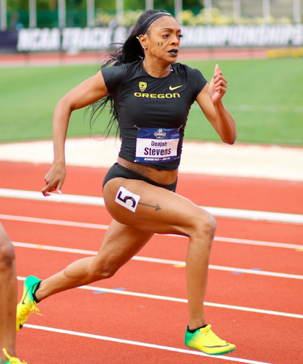
   1.  Running is not sprinting. If you stop reading here, you’ve learned something most people don’t understand. Sprinting is something you can do for a short period of time and requires full recovery to repeat. Anything lasting for more than five seconds is working on something other than speed.
Screenshot 2017-06-26 10.15.52I took this picture at the NCAA Track & Field Championships. Deajah Stevens is sprinting, not running.

   2.  Running does not improve speed. When football coaches encourage their players to run at full-speed over a three-hour practice, they are confused. No one can run at full-speed for three hours. Yes you can try to do your best over a three-hour period but it won’t be “full-speed”. Running is sub-max. Full speed is max-speed. Max-speed is sprinting. Running makes you good at sub-max running. Sprinting improves speed.
   3.  Weight lifting does not improve speed. Lifting weights will improve strength. That strength may transfer to athleticism but won’t directly improve speed. The strongest kids on the team are seldom the fastest. The typical weight room celebrates indiscriminant hypertrophy (bodybuilding). In my opinion, kids who lift weights get better at lifting weights. Beware of muscle-bound poster boys who live in a weight room. Strength coaches will tell you that great teams are made in the weight room, but remember, when you ask a barber if you need a haircut, he will always say yes.
Screenshot 2017-06-26 10.16.04Bodybuilding will make you slower. This guy looks good in the mirror but his strength is non-functional.

   4.  Racehorses are not workhorses. This will offend most coaches but it’s a fact. Horses that plow a field all day can’t win a race. Too many coaches take thoroughbreds and force them to plow fields.  If you want a fast team (and who doesn’t?), treat all your horses like race horses. Train them for speed, not work.
   5.  Sprinting is the most explosive exercise in the world. Nothing in the weight room moves at 10 meters per second. The most explosive lifts may approach 2 m/sec. I’m not telling people not to lift, but sprinting, in and of itself, builds functional strength that directly transfers to athleticism.
Screenshot 2017-06-26 10.16.20.pngLast season I coached the fastest 14 year-old in the nation, Marcellus Moore, #1 IL indoors in the 60m (6.86) and 200m (21.95). #2 IL 100m (10.41), #1 IL 200m (21.28). Marcellus did not get fast by lifting weights or surviving high volume workouts.
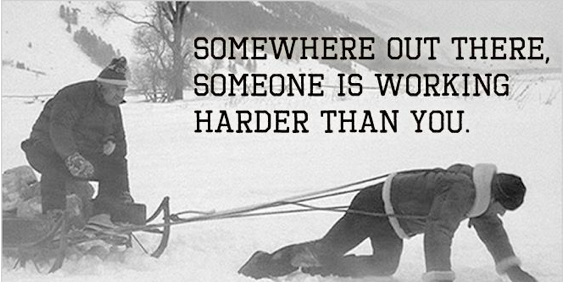
   6.  Any fool can get another fool tired. Know-nothing coaches often work their kids the hardest. Toughness wins! I believe toughness is just as genetic as speed. Coaches don’t create toughness by designing crushing workouts. Even if hard work created toughness, I would still opt for fast, energetic athletes. Slow and tired athletes lose no matter how tough they are. If you want fast kids, work smarter, not harder. To get faster, you must sprint intensely for five or six seconds and then rest long enough to do it again.
   7.  We are not the result of what we did yesterday. We are the sum of what we did for the last six weeks, the last six months, and the last six years (my “6-6-6 Theory”). Speed grows like a tree. Stay patient. Every year I time over 10,000 40-yard dashes. I time thousands of 10m flys with a Freelap timing system. I “record, rank, and publish” all measurements. Since speed grows like a tree, I measure often. Growth inspires.
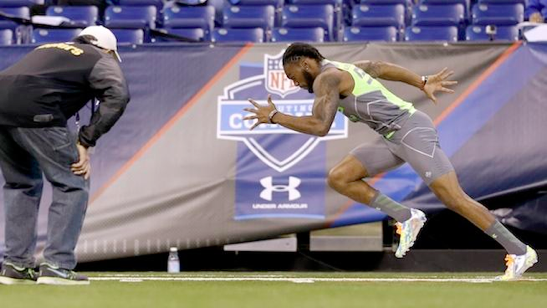
   8.  Speed is a barometer of athleticism. What metric is the #1 indicator of future success at the NFL Combine? The 40-yard dash is a measure of both acceleration (strength and explosion) and max-speed. Surprising to some, speed is not only important for running backs and receivers. The fastest offensive linemen are always drafted highest. The highest drafted 300-pounder will usually be the fastest 300-pounder. The best athletes are the best players.
Screenshot 2017-06-26 10.16.31.pngSlow people complain about the use of the 40 as a metric of football athleticism but the data is strong. Among the best football players entering the NFL, the fastest in the 40-yard dash usually have the best careers.
If no one reaches max speed on a basketball court, is sprinting irrelevant for basketball players? Josh Bonhotal, Director of Sports Performance for the Purdue men’s basketball team, believes max-speed sprinting to be the key to basketball athleticism:
“Too often, I see coaches overemphasizing conditioning during the offseason and never developing absolute capacities of strength, power, and speed. In particular, a common mistake is to attack repeat sprint ability when you have never truly developed speed and thus sprint ability itself.”
If most baseball players don’t steal bases, is sprinting irrelevant in baseball?
Major league baseball has found itself with a shortage of athleticism. Specialization has created players who are good at hitting and throwing but weak at explosive sprinting. Several major league teams are looking for ways to reverse this trend by making speed a priority in their farm system.
Even endurance sports like cross country, soccer, rugby, and lacrosse are beginning to explore speed training.
How about a non-running non-speed sport like volleyball? Sprinting and jumping use the same fast-twitch muscle fibers. Sprinting and jumping have a reciprocal relationship. Volleyball players jump high and move quicker as their 10m fly times improve.
   9.  Beware of “The Grind”.  Any coach who embraces “The Grind” is not a speed-based coach. You don’t train a racehorse by grinding unless you want to improve its ability to plow fields. Grinding improves grinding, not speed. Hard work seldom translates to undefeated seasons, but coaches are addicted to slogans and paramilitary thinking. Coaches live in constant fear of getting out-worked. Great athletes and great teams are a combination of smart training, enthusiasm, talent, and luck.
Screenshot 2017-06-26 10.16.45.pngHard work does not improve speed.
   10.  Sprinting improves sprinting. No one gets fast by running slow. I never train tired athletes. I never train beaten and battered athletes. Rest, recovery, and enthusiasm are more important than any workout. If I want to train kids two days in a row, I make sure today’s workout does not ruin tomorrow’s workout. My racehorses usually perform well.
Hopefully, I’ve convinced you that speed is critical to athletic performance and that speed must be trained wisely.
Where can you find training?
This is tricky.
Distance coaches who don’t understand sprinting lead some track programs. Distance training (running), by nature, is high-volume and process-driven. Some track coaches coach like they were coached in high school. Old school track and field was typically high volume. Distance runners ran ten 400s, sprinters ran ten 200s. For some perspective, Plainfield North’s hardest sprint workout this year was 3 x 200 with two minutes rest (sprinting at max-speed).
Tough, hard-working, masculine men who train their teams like armies lead too many football programs. These wannabe generals truly believe that putting kids through crushing workouts will make them tougher. They also believe that toughness wins games.
Screenshot 2017-06-26 10.16.56.pngMaybe this makes a Marine tougher, but it doesn’t make him faster.
Too many baseball programs encourage specialization. Kids never learn to sprint. The same can be said about basketball, volleyball, softball, lacrosse, soccer, and rugby.
Too many private trainers value weight lifting in the absence sprinting. Kids fall in love with the way they look in the mirror. Indiscriminate hypertrophy is a dumb idea and reduces athleticism.
I get emails from parents from all over the country. Where can I find a sprint coach?
Joining the track team is always the best option. In addition, some football teams are embracing shorter practices done at high speed and high intensity. With the exception of track and football, kids will seldom, if ever, be exposed to sprint training.
The only other place to find sprint work will be private training, but be careful. Don’t fall prey to muscle-bound Neanderthals and ex-college football players selling hard work and bodybuilding in the absence of speed. Sprinting must be the priority. You can’t plant beans and grow corn.


Tony Holler has taught Chemistry and coached track for 36 years at three different high schools, Harrisburg (IL), Franklin (TN), and Plainfield North (IL). Inducted into the ITCCCA Hall of Fame in 2015, Holler’s teams have continued to feature great sprinters. Along with Chris Korfist, Holler co-directs the Track Football Consortium held twice a year (June and December). Holler has written over 100 articles promoting the sport of track and field and sharing everything he knows. His articles can be found at ITCCCA.comFreelapUSA.com, and SimpliFaster.com. You can follow Coach Holler on Twitter @pntrack and email him at tony.holler@yahoo.com.

Blue Light; Sleep, Caner, and Sports Performance


Sleep: there aren’t enough hours in the day for this insignificant phenomenon that many bypass to get one last job done before the end of the day.  Some claim that sleep isn’t necessary for success, but do we have it wrong?  Are we missing out on opportunities to become successful or has the influx of social media via the technological advances made sleep a thing of the past?  How many have stayed up late at night just to scroll the news feed of your favorite social media platform to catch up on irrelevant news content that floods our brains?  Lets not forget your favorite television series that you must stay up for otherwise you might die if you have to wait until the next evening to see if your favorite male character proposes to his crush, right?
Many may raise the question of, “why is it important to sleep?”  According to the Division of Sleep Medicine at Harvard Medical School, truly understanding sleep is still a process that many scientists are continually researching to better understanding.1  Research has also found that sleep is an important process for not only repairing and rejuvenating the brain, but also for the development and plasticity of the human brain.  So why is sleep an overlooked aspect of overall health and sport performance? In the paragraphs to come, I hope to shed some light on some of the research done regarding blue light and sleep.  We will be looking at what has caused some of the issues with improper sleep hygiene, negative health implications it can pose, how it can be a hindrance to athletic performance, and helpful suggestions that may improve sleep for those who find it near impossible getting quality sleep.
Blue Light
I am sure that many have become accustomed to nightly routines of watching popular television shows, chatting with friends on small handheld devices, and staying up during the late hours to finish work.  Seems fairly senseless, right?  What many of us don’t know is how these small bedtime routines have actually altered our quality of sleep and life.  As we stay awake at night looking at the screens of these devices, our eyes are exposed to what is called blue light, or artificial lighting.  The artificial lighting that comes from many electronic devices affects the human circadian rhythm, which is the body’s natural wake and sleep cycle.2  Why is this significant?  Many studies have been published that continue to find the correlation of increased blue light exposure with the loss of sleep.  Although we get natural blue light from the sun, the amount of time many people look at screens that give off artificial lighting is alarming.  Just think about the number of kids and adults you see during dinner at your local restaurant or watching kids interact after school.  From personal observation, most are interacting in different ways that don’t involve verbal communication, but rather, communicating with the tips of their thumbs.  Moreover, technology and exposure to blue light causes disturbances of the central nervous system, which will put off the production of melatonin (sleep hormone) for up to 90 minutes making falling asleep more difficult.3
The body has a unique way of operating to ensure that many of the processes are functioning properly.  The pineal gland, a small region in the brain that is sensitive to lighting picked up through the eyes, and the suprachiasmatic nucleus, which controls the body’s circadian rhythm, are just two areas that blue light greatly affects.  To show how sensitive the brain is to blue light, think of it this way: you finally made it to bed after a long week with the hopes of getting the best sleep you’ve gotten in weeks; two hours go by and you need to empty your bladder because you’ve consumed water before going to sleep; upon entering the bathroom, you turn the lights on and the bright light shocks you like the New England Patriots Winning the 2017 Super Bowl in overtime; you then walk back to your room like a zombie, get into bed, and bam: you can’t fall asleep.  I am sure this has happened to many of you.  Light, especially at night, may be the cause of your sleepless nights.  As I mentioned above about the pineal gland being sensitive to light, it then signals the body to stop the production of melatonin because it believes it is light outside as a consequence of the late night light exposure.  Melatonin production is decreased, which then causes you to feel awake at three in the morning.
Health Implications of Blue Light
Technology is the now and it is our future, which is apparent amongst the millions of active users on a daily basis.  It is inside classrooms for educational purposes, how we do business, and how many communicate.  But is all of this good for humans?  Over the years more and more research is diving into this topic.  Whether you are a researcher or an observant citizen, you can see how technology has affected humans: good and bad.  Although these technological advances have many good applications in everyday life, there are many dangers that come with it.
Many people in developed countries have become accustomed to different forms of technology, but over the years an increased number of people are suffering from insomnia, obesity, seasonal affective disorder (seasonal depression), and cancer.   Going back to an earlier question: Is all this technology safe for humans?   A recent study conducted by the Breast Cancer Organization concluded that, Women who work at night -- factory workers, doctors, nurses, and police officers, for example -- have a higher risk of breast cancer compared to women who work during the day.  Other research suggests that women who live in areas with high levels of external light at night (street lights, for example) have a higher risk of breast cancer."4   Many may raise the question of, how does shift workers or residing in areas that have higher levels of external light have an impact on human health?  If you remember from earlier how I mentioned what blue light is and how it affects the body's ability to produce melatonin, it begins to make more sense.  These artificial lights that many are exposed to, especially night shift workers, have an internal battle with their body's natural sense of time and sleep.  This then causes the suppression of melatonin, which many researchers, including physicist Dr. Edward Carome, believe this is the beginning to many health complications. Dr. Carome has discovered that melatonin production at night is important because it acts as a “strong cancer fighting antioxidant.” Additionally, blind men have a decreased risk of prostate cancer than those that can see, and blind women have a decreased risk of breast cancer than those that can see.  The reason for this is because the blind are maximally producing melatonin compared to people that can see who do not maximally produce melatonin.5
Moreover, a study (of many) conducted by Professor David Blask Ph.D, M.D. of Tulane University, experimented with blood samples from cancer patients at different times of the day to monitor melatonin levels.  What Dr. Blask found was “exposure of human subject to bright light at night suppresses the nocturnal circadian melatonin signal resulting in high, daytime-like rates of tumor metabolism and grown."6  This is furthering evidence of what has been found by many researchers.  From the number of studies, one could make a safe assumption that melatonin production and sleep are important necessities for health and well-being.
Sports Performance
As a former high school and collegiate athlete, working out, eating healthy (what I thought was healthy), and practices played a major role in everyday life. During my athletic career, there were only a few times sleep was a topic of discussion (Yes, there is a good chance that I was zoned out like a squirrel in a tree on a warm spring morning and missed these conversations, but that’s besides the point).  Like many, the small things are often viewed as insignificant and if it can’t be measured in a weight room, well, it really isn’t important.  A significant portion of increased athletic performance and adaptations come from the sleep we get in the days and weeks leading up to practices and competitions3. Also, the body needs the proper amount of sleep for natural responses to occur such as the natural release of the human growth hormone (HGH), muscle repair/gains, and maintenance.  In a study published by the National Strength and Conditioning Association athletes require a greater quantity of sleep to recover sufficiently from injury, intense training periods, and competition .8 “Training is just a small part of getting bigger, faster, and stronger.  Some of the most important responses/adaptations happen during sleep."3
Assuming that most of us have gone through a night or two where sleep was nearly impossible, think back on how you felt the next day.  Maybe you felt sluggish or moody, had increased junk food cravings, or felt a decrease in your thought process.  These examples sometimes become more apparent with athletes that have had a rough night of sleep.  Many great coaches are able to sense this without any high-end technology by reading body language. Sometimes our eyes are the best tools to assess when athletes have had a good or bad night of sleep.  According to John Underwood’s study on sleep and athletic performance, sleep loss can result in an eleven percent reduction in time to exhaustion during exercise.  Additionally, “when exhausted, blood flow to the brain decreases.  Blood flow is required for pre-movement and balance. When the brain doesn’t work, the body doesn’t work."3 This is no coincidence given that our brain is the control center for many of the functions that take place in our bodies. Sleep is a must; it can be the difference between a great performance and mediocre performance.
Moreover, because the education of sleep hygiene is sometimes forgotten, many athletes look for different alternatives to offset sleep debt.  Some athletes have resorted to various supplements to help increase energy, with energy drinks being one of the most popular.  Side note: if you are someone who depends on energy drinks to get through the day or to get you “amped” for your gym session, this is a problem.  In most cases, if a sound nutritional and sleep routine is followed, this should give one optimal levels of energy.  Caffeine supplementation is a widely talk about topic within the sports performance field, but athletes sometimes become dependent.  A study was conducted with a group of Navy Seals, which yielded positive results to mental and physical performance when consuming caffeine.  It is important for athletes and coaches to understand that the stimulation of the central nervous system can sometimes put an athlete at an over-aroused state, which can lead to declined performances.3  Although adult athletes have shown positive effects from caffeine, parents have been advised to prohibit young athletes under eighteen the consumption of energy drinks.  A study published by the United States of America Football Organization, warns about increased anxiety and arrhythmias as a result of children who take caffeinated energy drinks.  In addition, the same study found that individuals who ingest caffeinated energy drinks more often suffer more mistakes because of over-arousal, an increased heart rate, increased blood pressure, and a disrupted sleep cycle.9
We often forget the importance of good brain health.  The brain accounts for many functions within the body, but often the last to get attention when training. Although caffeine has been shown to increase mental and physical performance, athletes and coaches must understand the importance of getting proper sleep and naturally nourishing the brain instead of depending on stimulants to overcome sleep deficits and to increase performance.  I am not saying that caffeine is bad.  Research has found advanced athletes benefiting from caffeine.  However, what I am saying is that young athletes should not be turning to these types of supplements/stimulants to offset sleep debt or a bad nutritional diet.  There are many natural ways to increase energy that can be more beneficial than teaching youth athletes that they can get a quick and easy fix to mask a bad diet through beverages or supplementation.
How to improve sleep quality
Many alternatives exist when trying to implement consistency with sleeping patterns.  One of the most popular choices amongst many Americans comes in the form of medication: synthetic melatonin. Although the synthetic form of melatonin does help some with sleep, many become dependent, which affects the human body’s natural ability to produce melatonin.  The Sleep Foundation advises those that choose to consume synthetic melatonin to be cautious because it is not regulated by the Food and Drug Administration. “For melatonin to be helpful, the correct dosage, method, and time of day it is taken must be appropriate to the sleep problems.10 Like many over the counter supplements, it is important to do a little homework before purchasing.
If melatonin supplementation is not a good solution, then what is the best or next alternative?  Consistent sleep patterns have been shown to help with sleep hygiene.  A structured schedule that consistently has one going to sleep at the same time and waking up at the right time can help with those that suffer from insomnia or other sleeping disruptions.  In addition, there are many applications one can download, such as The Calm App, which provides guided meditation and breathing techniques.  This is something I have tried and saw great results with. Furthermore, stretching before bed has been a beneficial and calming practice I have implemented to increase sleep.  Both have benefited me in my own search for better sleep, but decreasing blue light has been the best choice for increasing sleep.
Here are a few sleep suggestions that the Harvard Medical School Heath News Letter suggests 11:
-Avoid looking at bright screens beginning two to three hours before bed.
-Expose yourself to lots of natural bright light during the day, which will boost your ability to sleep at night, as well as your mood and alertness during daylight.
-Use dim red lights for night-lights. Red light has the least power to shift circadian rhythm and suppress melatonin.
Here is a list from research articles on the effects of sleep deprivation
Those who consistently use energy drinks are 1.8 times more likely to report morning sleepiness than those who do not use energy drinks.3
Artificial lighting could be making us frail, withering muscles and making bones more fragile.12
Lack of sleep impairs information retrieval, or the ability to access learned information.3
Students who pull all-nighters: 2.95 GPA, Students who don’t pull all nighters: 3.20 GPA.3
Athletes build up sleep reserves or deficits over1-3 days.3
Sleep deprivation leads to disruption of training intensity and performance at competition.13
A growing body of evidence suggests that a desynchronization of circadian rhythms may play a role in various tumoral diseases, diabetes, obesity, and depression.14
I’m pretty sure that at least many of the sleep disorders we are facing epidemically are related to evening or nighttime light.14
Sleep-related problems affect 50–70 million U.S. men and women of all ages.14
Disrupting this circadian rhythm has also been linked to medical issues like depression, obesity, breast and prostate cancer, and cardiovascular disease. It’s even associated with sleep disorders like insomnia and delayed phase sleep disorder, possibly because it causes the suppression of melatonin, a sleep-inducing hormone.15
Eve Van Cauter, PhD, who termed sleep deprivation "the royal route to obesity."16
“Continued sleep shortages contribute to depression, heart disease, lowered immunity, obesity, and type 2 diabetes, among other illnesses."17
Brining it all together:
Over time, blue light has been shown to affect not only sleeping patterns, but also the formation of cancer cells.  Blue light also increases the likelihood of depression, obesity, and seasonal affective disorder – just to name a few.  This is a growing topic within health fields and sports performance, but we must continue to do our homework to get a better understanding of our less than optimal sleep patterns.  For years I have often wondered and grew curious to some of the changes that I have gone through (eating patterns, mood, decreased motivation), and it was not until I started taking a deeper look into sleep and its effects that I began to get a better understanding of the importance of this amazing phenomenon.  Being an athlete and working with many athletes, I often question whether us coaches are giving today’s youth the best information to not only positively impact their athletic careers, but to also impact their lives after sports.  Obesity, depression, and sports injuries are continually growing and some of the same information continues to be regurgitated in different ways, (better training models, nutrition, and the list goes on), but I often find sleep a topic that many coaches briefly talk about. Although there is much more to learn on this topic (and I have only hit the surface), with my findings I hope to help many become more aware of the importance of understanding blue light and how it can hinder our sleep patterns.  Technology is increasing and this may be the devil’s recipe for some of the health issues many of us face when dealing with sleep. Sleep is like water, you need it to function and survive.  Don’t let the quality of your life decrease because of your sleep hygiene.
___________________________
Kendrique Coats is the owner of Coats Performance, which provides speed and agility training in Frisco, Texas and surrounding areas. Over the years, Coats has spent most of his coaching time on the high school level coaching boys and girls track and field as well as overseeing strength and conditioning programs, which included stops at Pontiac Township High School in Illinois and Bloomington-Normal, Illinois. Now the head track and field coach at Dallas International School in Dallas, Texas, Coats looks to bring many of his training and coaching philosophies to the new program. Coats has written several articles including “Why I Stopped Yelling and Started Coachingalong with Early Sports Specialization. For more on Coach Coats and his work, be sure to follow on Twitter @kendriquecoats, Instagram @CoatsPerformance, and his website www.coatsperformance.com. You can also connect with Coach Coats via email at kcoats@coatsperformance.com

Sources
1) MG, Frank. "The Mystery of Sleep Function." Why Do We Sleep, Anyway? | Healthy Sleep. Sleep Medicine at Harvard Medical School, 18 Dec. 2007. Web. 05 Apr. 2017.
2) "Blue Light and Your Eyes." Prevent Blindness. N.p., Mar. 2017. Web. 26 Mar. 2017.
3) Underwood, John. “Technology and Sleep.”Sleep and Recovery. Life of an Athlete, n.d. Web. 26 Mar. 2017
4) "Light Exposure at Night." Breastcancer.org. N.p., n.d. Web. 01 Apr. 2017.
5) Carome, Dr. Edward. "Is Blue Light the New Smoking." Interview by Daniel Vitalis. Audio blog post. Rewild Yourself. N.p., 1 Sept. 2015. Web. 1 Apr. 2017.
6) Blask, Dr. David E. "Research Interests." Structural & Cellular Biology. Tulane University- School of Medince, n.d. Web. 1 Apr. 2017.
8) Teng E, Lastella M, Roach GD, and Sargent C. The effect of trainign load on sleep quality and sleep perception in elite male cyclists. In: Little Clock, Big Clock: Molecular to Physiological Clocks. Kennedy GA and Sargent C, eds. Melbourne: Chronobiology Society, 2011. pp. 5–10.
9) Frollo, Joe. "Experts Warn against Caffeinated Energy Drinks for Young Athletes." United States of America Football, 20 Feb. 2015. Web. 31 Mar. 2017.
10) "Melatonin and Sleep." Sleep Topics. National Sleep Foundation, n.d. Web. 1 Apr. 2017.
11) Publications, Harvard Health. "Blue Light Has a Dark Side." Harvard Health. N.p., 2 Sept. 2015. Web. 01 Apr. 2017.
12) Johnston, Ian. "Artificial Light Could Be Making Us Prematurely Frail." The Independent. Independent Digital News and Media, 14 July 2016. Web. 05 Apr. 2017.
13) Souissi N, Chtourou H, Aloui A, Hammouda O, Dogui M, Chaouchi A, and Chamari K. Effects of time of day and partial sleep deprivation on short term maximal performnces of judo competitors. J Strength Cond Res 27: 2473–2480, 2013.
14) Holzman, David C. "What’s in a Color? The Unique Human Health Effects of Blue Light." Environmental Health Perspectives. National Institute of Environmental Health Sciences, Jan. 2010. Web. 05 Apr. 2017
15) "External Lights Affect Your Sleep." Sleep.Org. N.p., n.d. Web. 05 Apr. 2017.
16) Cauter, Eve Van. "Obesity and Sleep." Sleep Topics. National Sleep Foundation, 2003. Web. 05 Apr. 2017.
17) Reports, Consumer. "Why Americans Can't Sleep." Consumer Reports, 14 Jan. 2016. Web. 05 Apr. 2017.